Last updated ·
Coffee cup reading: how to read the grounds in your cup
Coffee cup reading means flipping your cup after Turkish coffee and reading the shapes the grounds leave on the walls. Here's the ritual, where to look, what each part of the cup says about timing, and the symbols you'll meet most.
What coffee cup reading is
Reading cups is called tasseography, from the French word tasse, a cup. The coffee version grew up wherever coffee is boiled rather than filtered: Turkey, Greece, the Arab world, the Balkans, Iran. Turkish, Greek and Arabic coffee all leave the same thick, fine sludge, which slides down the walls when you flip the cup and dries into shapes.
In Turkey it's kahve falı, in Greece kafemanteia, and in English people mostly search for it as Turkish coffee fortune telling. That name oversells it. Nobody at the table knows what next month holds. A good reader looks closely, says what's actually there and turns it into a conversation about what's on your mind.
It's a social habit first: a friend or an aunt reads your cup over a second coffee. A Turkish saying has it that one cup of coffee is remembered for forty years. The reading is part of why.
What you need
- Unfiltered coffee. Turkish, Greek or Arabic coffee, ground as fine as flour and boiled with its grounds in a small pot. Filter coffee, espresso, pods and instant leave nothing in the cup to read.
- A pale cup with a saucer. A small cup, white or cream inside. A pattern hides shapes; a dark glaze hides everything.
- Good light. Daylight from a window beats a ceiling lamp, which mostly puts the shadow of your own head in the cup.
- A question, if you like. Optional. Some people keep one in mind while they drink, and the saucer is where it gets its answer.
The ritual, step by step
- Drink slowly and stop at the grounds. When you feel the sludge on your lip, stop. That dark layer is what gets read.
- Swirl. Hold the cup by the handle and give it a few gentle circles so the grounds climb the walls.
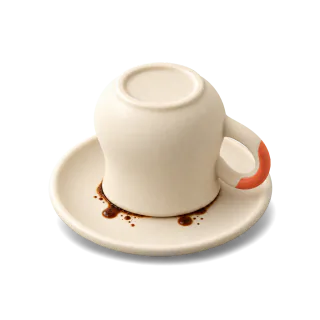
- Saucer on top, then flip. Put the saucer over the cup like a lid and turn both over together in one movement. A little coffee runs onto the saucer. That's fine.
- Wait. Leave it upside down until the bottom of the cup feels cool to the touch.
- Lift. Turn the cup the right way up, slowly. Some grounds stay on the saucer. Keep both.

Why the cup has to cool
Upside down, the wet grounds slide toward the rim and set. Lift too early and you get runny streaks instead of edges. Once the base feels cool, usually after five to ten minutes, the shapes have settled. In Turkey people often rest a coin on the upturned base to speed things up. Mostly it gives you something to do.
How to look at a cup
Hold the cup with the handle toward you. The handle side stands for you, so start there, then go round and work down, rim first, bottom last. Turn it slowly; shapes appear and vanish with the angle.
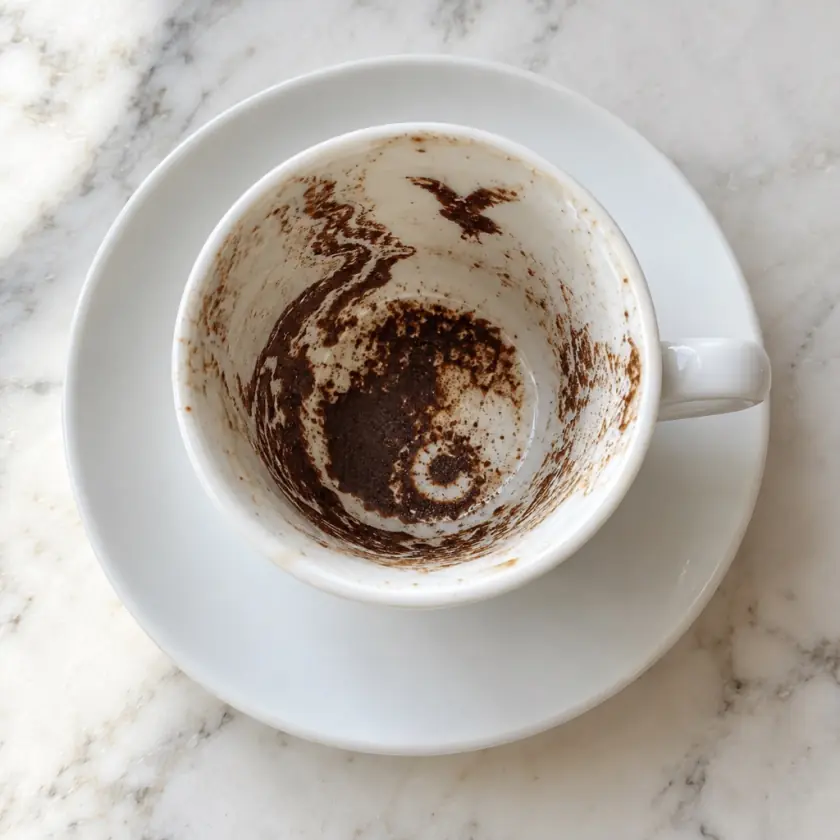
Shapes, not blobs. Most of a cup is texture: smears, speckles, dark patches. A shape is an outline you could point at, grounds against clean porcelain or a clean patch inside the grounds. The test: if a friend can see it once you point, it counts. If you need a minute to explain it, let it go.
Size and clarity. Readers treat a big, sharp shape as loud and a small, faint one as a whisper. A cup crowded with grounds tends to read as a busy stretch, a pale, open cup as a quieter one. Neither is better.
Neighbors. Shapes close together get read together. A bird beside a letter is news that comes in writing. A road running toward a house is a trip that ends at home. Two to four clear shapes are plenty; let the one that jumped out first lead.
The zones and what they say about timing
Where a shape sits changes what it says, mostly about when. Picture rings from the rim down to the floor, plus the handle and the side across from it. Skycup reads the zones like this, close to how most cup readers do.
| Zone | Where it is | What it speaks to |
|---|---|---|
| Rim | The band just inside the edge | Soon, within days |
| Upper wall | Just below the rim | The coming weeks |
| Lower wall | Down near the floor | A month or more away |
| Bottom | The floor, where the grounds pile up | The past, what's settled, what sits in your heart |
| Handle side | Right beside the handle | You, home, family, your closest people |
| Far side | Straight across from the handle | Other people, work, the outside world |
| Saucer | Grounds left on the saucer | How it closes, the answer to your question |
So the same bird means different things in different spots. On the rim the news is close: think days, not weeks. On the lower wall it's coming the scenic way. At the bottom it's something you already heard and are still turning over. Beside the handle it's about your own people; across the cup it comes from work or someone outside your circle.
Timing in a cup is a tendency, not a calendar. Read the rim as "soon", not "Thursday".
The saucer
Many readers save the saucer for last, as the closing line, and look there for the answer to whatever you asked. A clear shape is a clear reply; an almost clean saucer means the cup has said its piece. And if the cup sticks to the saucer and won't lift, some readers call that a wish granted. Nice story. Not a promise.
Common coffee cup symbols and meanings
Skycup's dictionary has 46 shapes. Here are sixteen you'll run into early, one line each. The full symbol dictionary shows how every one shifts from the rim to the bottom.
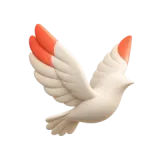




- Bird: news on its way. Near the rim it lands soon; at the bottom it takes its time.
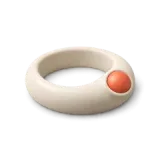
- Ring: a promise, made, asked for or overdue. Whole reads as a yes, broken as time to talk terms again.
- Road: movement. Straight is easy going; winding is a detour you'll be glad you took.
- Letter: a message, a form or something to sign. Read the small print.
- Key: something opens up, a new place, an answer, a yes you've been waiting on.
- Heart: affection, given or received. Next to the handle, it's someone at home.
- House: home matters, from a guest to a move to finally fixing whatever squeaks.
- Tree: slow, steady growth. Visible roots bring family into it.
- Mountain: a goal that takes effort. Several peaks make a staircase, not a wall.
- Fish: good luck swimming your way. More fish means more chances, not more cash.
- Bridge: a gap closes, through making up or a lucky connection.
- Crown: recognition. Someone finally notices what you've been doing.
- Moon: moods and things left unsaid. A crescent starts a new chapter.
- Spiral: going round the same decision. The cure is deciding.
- Cloud: a worry that's bigger in your head than in real life. It passes.
- Eye: attention on you, curious more than anything. Finish your plans before you show them.
How Skycup reads a coffee cup
Skycup is an app for iPhone and Android, coming soon. It does the looking with you, then adds what a kitchen table can't: the sky.
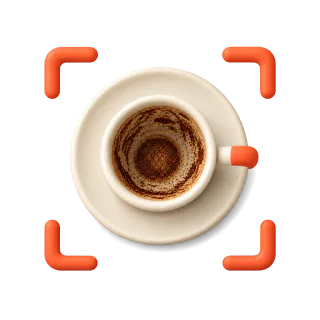
The cup map. Pick coffee, add a question if you have one, shoot the inside of the cup from straight above and send it. A blurry or dark shot, or a cup still upside down, gets turned down without costing you a reading. Then Skycup finds the clearest shapes and pins each one on your own photo with its zone, so BIRD · RIM points at an actual bird on your actual rim. If the saucer is in the photo, it gets read too.
Your chart and the sky right now. Skycup works out your birth chart on your phone: Sun, Moon, rising sign and twelve Placidus houses. The rising sign and houses need a birth time. Want yours now? Try the rising sign calculator. Each reading uses the sky at the minute you send the cup, so a house shape by the handle reads differently while the Moon crosses your 4th house, the one about home.
Did it happen? Each reading names one everyday thing to watch for, timed by its zone: days for the rim, weeks for the walls. When the day comes, the app asks. Answer yes, partly or no, and after a few cups you'll see which shapes keep coming back for you and how often they matched what happened.
An honest note
The shapes in your cup are really there, and the sky is computed for the minute you send it. What they mean comes from an old tradition, put into words by AI. Take it the way you'd take a friend reading your cup: for fun and a little reflection, not as advice. Health, money and legal calls belong with people who can actually look at your situation.
Questions
Can you read your own coffee cup?
Tradition says someone else should, and there's a point to it: in your own cup you tend to see what you hoped to see. Plenty of people read their own anyway. For a second pair of eyes, hand it to a friend or send it to Skycup.
Can you read espresso or filter coffee grounds?
Not really. Filter coffee keeps its grounds in the paper, and espresso packs them into a puck. You need coffee ground very fine and boiled with its grounds, like Turkish, Greek or Arabic coffee. A pinch of cardamom in the pot is fine.
What if I can't see any shapes?
Find better light and turn the cup. Squinting helps more than you'd think. Still nothing? It's a quiet cup, and those are allowed. Skycup agrees: a photo with nothing to read gets turned down, not stretched into a story.
Is Turkish coffee fortune telling real?
The shapes are real and the tradition is old. Whether a cup knows anything about your next month is another matter, and nobody has shown that it does. Treat a reading as a prompt to talk about what's on your mind, often the useful part. If you want to keep score, Did it happen? does that.
How is it different from tea leaf reading?
Same idea, different sediment. Tea leaves cluster into shapes where grounds dry into outlines, nobody waits for a tea cup to cool, and in tea the bottom speaks to the long run, not the past. The tea leaf reading guide has the tea ritual.